
In Chancery
A Dan Foster Mystery (short story)

An appeal for help from a childhood friend brings back memories of life as a pickpocket on the streets of London for Bow Street Runner Dan Foster as he tries to find a killer.
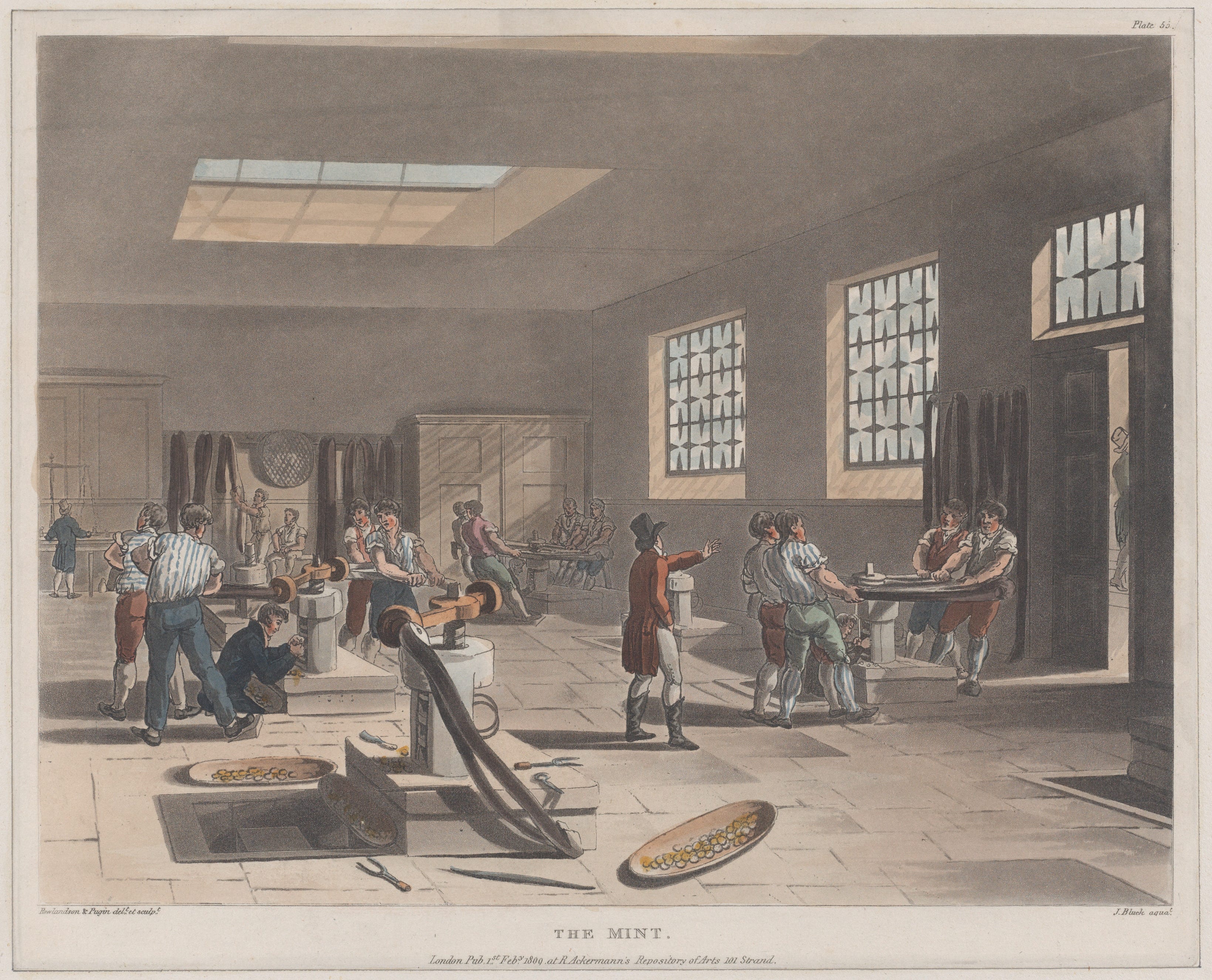
Workers feeding metal blanks into presses that hold dies to stamp the coins at The Mint at the Tower of London.
“The man who robbed the Mint! A good arrest, Mr Foster!”
The Newgate turnkey made an ugly, gurgling sound. Though Dan did not join in the man’s laughter – the man they had just locked up was going to hang and that was no laughing matter – he too thought it was a good arrest. The prisoner was one of three Tower Guardsmen who had been employed to operate the heavy machinery used to stamp coins at the Mint. They had held a monier’s apprentice at gunpoint and stolen four bags of gold destined to be turned into guineas. Only two days after the robbery, Dan had tracked them to lodgings near the Nag’s Head, a flash house in Tothill Street. He had taken half a dozen armed officers with him but the precaution had been unnecessary. There were two men in the room and they were dead, shot by the man who had persuaded them to join him in the robbery, never intending to share the proceeds.
He had never intended to be caught either. It had been weeks before Dan finally caught up with him in a tavern near Wapping Stairs, where he had been negotiating passage with an ask-no-questions sea captain.
Having seen the key turned in the lock of the cell door, Dan followed the turnkey back to the Porter’s Lodge. They passed the tap room where the usual crowd of impoverished prisoners clustered on the threshold in the hope of picking up stray pennies running errands for those Newgate inmates who had money to spend. Charity they could not expect. The drinkers inside were already in fine voice, bawling lewd songs into the tobacco-heavy air.
When they got back to the Porter’s Lodge it was crowded with half a dozen prisoners who had just been brought in on foot. A sad, beggarly lot, they huddled together while they waited their turn to be called forward and have their details entered into the prison register. It was a scene Dan had seen scores of times and he only glanced at it.
“Chancery!”
A woman broke away from the group and flung herself at him. A startled warder grabbed her arms and dragged her back. Kicking and struggling in his grip, she screamed, “Chancery! Chancery!”
“Get that drunken slut out of here,” the turnkey snapped at the warder. “Sorry about that, Mr Foster.”
“Wait,” Dan said. “Let me look at her.”
The warder relaxed his hold on the woman, but did not let go of her arms. Panting, wild-haired, and dishevelled, she stopped fighting and met Dan’s gaze. She wore a faded, dirty dress; heavy, well-worn shoes much repaired; and a scanty neckerchief that left much of her bosom uncovered. She looked exactly what she was: a woman who lived on the streets by whatever means she could.
“I’ll speak to her,” Dan said. “In private.”
The warder looked at the turnkey, who nodded agreement. They jostled the rest of the prisoners back into line and out of earshot, much to their disappointment.
“No one’s called me that in years,” Dan said to her.
She almost smiled. “Chancery Dan. If I hadn’t pulled you off that other boy, you’d have pulped him to nothing. Do you remember?”
Dan did remember. It had been not long after he was recruited from the streets by one of Weaver’s older boys, lured by promises of food, drink, a roof to sleep under. And he had got those at first, in the Warehouse, a rotting, cramped house in an alley behind Church Street in St Giles. After a few days, Weaver had set him to earning his keep. He learned to pick pockets, lift from shops, scramble through scullery windows while householders slept. Children who did not learn well or fast enough were put out to whore. Dan’s pickpocketing skills had been of the best.
He had earned the nickname Chancery when one of the bigger boys picked on him on his first night at the Warehouse. Thought he was a novice in these affairs, but Dan had already been living on the streets a year or more, since he had watched his mother’s gin-soaked body carted away by the parish officers. When they had gone he had come out from his hiding place in the alley and scarpered before the beadle got to him and turned him parish apprentice.
He had trapped the boy’s head under one arm and pounded it with his free fist. ‘In chancery’, the pugilists called the move.
There had been a girl standing by. She had laughed and called out, “Chancery! Let him go.”
He remembered her voice, so sweet and merry, and her face, still young enough to be pretty. It was her voice that made her living. On weekdays she warbled bawdy songs on the streets, with gestures and dances to match. On Sundays she raised her eyes heavenward and trilled hymns outside churches and chapels. Sometimes Dan and a couple of other boys worked while she sang, diving into pockets while she held the crowd’s attention.
Now, with age and rough living, her voice had lost its sweetness and her face was hard and worn. Yet in her eyes there lingered something of the lively girl who had looked out for him.
“And now you’re a Bow Street officer. Who’d have thought things would turn out so well for you?”
She did not speak grudgingly. Luck was luck, however it fell. Dan’s fists had been the saving of him in more ways than one. He had been spotted fighting by Noah Foster, a retired pug who trained boxers at his gymnasium in Cecil Street. He had taken Dan off the streets, given him a home, and trained him to fight scientifically.
“What are you in for now, Meg?”
“Murder. But I didn’t do it, Dan. A thief and a whore I may be, but I’m no killer. You know that, don’t you?”
He did not know it, not yet. “So how did you come here?”
“Me and Jack the Sailor broke into Widow Cooper’s house on Dean Street night before last. The old lady’s half-deaf so Jack went upstairs to see what he could nab. There was someone else up there. I heard him shout who’s there at Jack and then there was a scuffle and they ran down the stairs so I dived under a table. The man ran out the house and Jack came after, yelling, ‘The old lady’s dead! Get out of it!”, and was out the front door too. I was crawling out from under the table when the constables arrived. One of chased after Jack, but he got away. The other arrested me for beating the old woman to death with a poker. But I never touched her, Dan. Ask Jack. He’ll tell you. It wasn’t me.”
“I doubt his word would convince a jury. They’re more likely to think Jack killed Mrs Cooper, and they’ll hold you just as guilty.”
“But I didn’t do it, and no more did Jack. It was the other man.”
“It’s not much of a story, this tale of another man. What did he look like?”
“I never saw him. Jack saw him. He’ll tell you.” She clutched his arm. “You have to help me, Dan. They’re going to hang me.”
Dan put his hand over hers. “There’s not much I can do, Meg. The only thing that will do any good is finding the killer.”
“Then you’ll do that, won’t you?”
“I can’t promise anything…Where will I find Jack?”
“He’s been sleeping at Higgins’s lodgings in Dyot Street.” She raised his hand to his lips and kissed it. “I knew you wouldn’t let me down, Chancery.”
***
It was late when Dan arrived at Higgins’s lodging house, lantern in hand. There had been no point going before anyone had settled in for the night. The bruiser who collected the money for the landlord let him in and pointed to a door at the end of the grimy corridor. Dan ducked his head and descended the rickety wooden steps.
The house smelt of cesspool, damp blankets, rotting food and filthy human bodies. The smell was stronger in the cellar, trapped between streaming walls and mildewed ceiling. The beams from Dan’s lantern flared into a gloom lit only by a few scattered rushlights and guttering candle ends. Dan picked his way between the heaps of straw and rags. Lice-ridden heads shot up, bloodshot eyes blinked, hands flew to faces to shield them from the rays, or recognition.
When he asked for Jack the Sailor, all he got was sullen stares and curses. Eventually, realising he was not going to leave them in peace until someone answered him, one of the lodgers pointed and grunted. Dan moved deeper into the chamber, where the air thickened and clung to his nostrils. From there he was directed through an archway into a smaller, closer annex, also packed with bodies.
“Bow Street Officer,” he called over the human lumps on the ground. “I’m looking for Jack the Sailor.”
A bundle by his right foot shifted, a bony hand uncurled a finger, and a man’s voice rasped, “That’s him.”
Jack was lying on his side, his face to the wall. He was dead drunk and did not stir when Dan called his name. He did not move when Dan prodded him with his booted foot, nor when Dan crouched beside him and shook him. His arm and head flopped over. Not dead drunk. Dead.
Dan turned him onto his back. A smell so foul it penetrated even the rank vapour of the den rose from him. He had died purging and vomiting. How had no one noticed the man’s death agonies?
Dan kicked the bony bundle. “You. What’s your name?”
“F*** off.”
Dan kicked him again. “This man’s dead. Do you want me to arrest you for his murder?”
Bony shot up. “It wasn’t me. He was like that when I came in.”
By now the other men and women in the annex were sitting up and showing an interest, wondering when their chance would come to rob the corpse. They all had the same story to tell: Jack had been there when they got in. For all they knew, he had been lying there all day.
Dan pulled Jack’s ragged coat over his face. A half-eaten round loaf rolled from under it onto the dirt floor. The bony-fingered man grabbed it. Dan snatched it from his mouth.
“What’s your bloody game?” the man snarled.
“He died of poison, and this is probably what killed him.”
***
If Dan had left the cellar to fetch the doorman, Jack would have been stripped naked by the time he got back. Bony cursed and damned all nabmen to hell, but when offered a few pennies, fetched the doorman. Often when someone died in a place like this, the body was carried as far as the nearest alley or kennel and left to be someone else’s problem. Now, the bruiser on the door would have to cart it to the workhouse morgue. It would all come to the same in the end: a pauper’s burial. But first Dan would send for a surgeon to open the stomach. There was a man living on Bow Street who the officers often asked for advice.
Walking along Dean Street the following morning, Dan mused on how different Mrs Cooper’s funeral would be. There would be plumed horses pulling a gleaming hearse, black-clad undertakers, mourners, neighbours lining the street, and a clergyman to send her coffin to a grave marked with marble. There was no similarity in the manner of their deaths, except that neither had been natural. If there was a connection between them, other than coincidence, Dan could not see it.
A plump, neat, servant let him in. In her fifties, she had lived long enough to see many troubles and though her eyes were puffed with tears she dutifully showed him into a drawing room. She asked him to wait while she told Mr Cooper, the mistress’s son, he was there.
Samuel Cooper was a tall man in his mid-thirties, still handsome but showing signs of fading youth in the flecks of grey in his thick black hair. His face was tanned and the skin around his eyes crinkled, as if he had spent some time living out of doors. He had a distracted air, as well he might, and a nervous habit of running his fingers through his hair.
“Principal Officer Foster? I had not sent for a Bow Street officer.”
“I’m here all the same,” Dan said. “It’s a serious crime.”
“Yes, of course. But I can’t tell you anything more than I told the other officers. I came home from the theatre to a house full of constables and my mother – my mother–” He sat in an armchair and lowered his head onto his hand.
Dan remained standing. He took out his notebook. “Was anyone with you at the theatre?”
“Yes. We went to see Cumberland’s Joanna of Monfaucon at the Theatre Royal and had supper afterwards.”
Dan wrote down the names and addresses of his two companions. “Did your mother have any visitors while you were out?”
“Only Mr Roberts. He came most evenings. He’s an old friend of the family.”
“Where will I find him?”
“He runs the Society for the Alleviation of Want Amongst the Deserving and Industrious Poor, on Castle Street. My mother was one of the patrons.”
“And after Mr Roberts left, your mother went to bed. Was she alone in the house then?”
“Yes. She had given Mrs Dwyer the evening off to visit a sick relative. Mrs D’s the housekeeper. She’s been with us for years.”
“I’ll need to speak to her…I gather your mother was deaf.”
“She was hard of hearing, yes.”
***
“Deaf as a post,” Mrs Dwyer said. “Though it came and went, depending on the circumstances, if you get my meaning. But she always had ears for a sad story and a plea for charity, did Mrs Cooper. Lord knows how much she’s given to the Industrious Poor over the years. Well, she hadn’t got anyone else to spend it on, had she? More coffee, Mr Foster?”
“Yes, please.” Dan slid his cup along the kitchen table and the housekeeper refilled it. “What do you mean she hadn’t got anyone else to spend it on? What about her family?”
“There’s only Mr Samuel, but he’d run away from home, hadn’t he? Some idea he wanted to go on the stage. Where he got that from, I don’t know. Mr Cooper put his foot down, of course. ‘You’ll follow me into the business, my lad, or never spend another night under my roof.’ No more did he. His father died while he was gone. Poor lad. He’s hardly been back in his mother’s arms six months and now this.”
“You don’t say so,” said Dan.
***
“If you wouldn’t mind waiting five minutes, Officer, while I just finish handing out these meals.”
Dan leaned against the wall behind the counter where a rosily beaming Mr Roberts and two morose women doled out hunks of bread and soup. The Castle Street hall with its bare, dark-brown walls was filled with ragged men, women and children, silently eating their broth from wooden bowls. Most of them had proof of their industry tucked under the benches: trays of matches; bundles of straw for mending chairs; shoe blacking. One boy sat hunched over a crossing-sweeper broom held tight between his knees. Dan wondered how many of them had borrowed the paraphernalia for the occasion.
Mr Roberts ladled out the last helping, wiped his hands and turned away from the cauldron. “Well, now, Officer, I’m all yours. Let’s go to my office, shall we?”
Dan followed him upstairs.
“In you go…sit down, sit down, make yourself comfortable.”
It was indeed a comfortable room, with armchairs, carpets, curtains, bookshelves, a fire in the hearth, and a desk with a leather chair. Its occupant was a comfortable-looking man too, well fed and well dressed as were most of the dispensers of charity Dan had met. Roberts sat at his desk and Dan opposite him.
“How can I help you in this tragic business? Do you not have the murderer in prison? A young woman, I believe. Sadly fallen, sadly fallen.”
“Sadly fallen she might be,” Dan said, “but I’m not convinced she did it. It seems there was someone else in the house.”
“Yes, there was an accomplice who ran away, wasn’t there? Are you any closer to finding him?”
“He’s found and he’s dead, and I don’t believe he killed Mrs Cooper either. Could you tell me about your visit to her house that night?”
Mr Roberts sighed. “That fatal night. We played cards and drank tea, as usual. Samuel had gone out.” He frowned. “To the theatre.”
“You don’t approve?”
“It was the theatre that lay at the bottom of all the family’s trouble. I’ve known Samuel since he was a boy. He was a jolly, careless little fellow. I never dreamed his light-heartedness would turn to viciousness. But it did, it did. He defied his father and broke his mother’s heart when he ran away. They had no word of him for twelve years, until he turned up last September, shabby, footsore, half-starved. Of course, Mrs Cooper forgave him on the spot, and believed his tales of a life of struggle and hard work. But that was not the truth by a long way, Mr Foster, not by a long way.”
“What was the truth?”
Mr Roberts folded his hands on his stomach and leaned over the desk. “Gambling, debt, and worse, Mr Foster; gambling, debt, and worse.” He lowered his voice. “Burglary.”
“Burglary?”
Mr Roberts sat back in his chair, the leather squeaking beneath him. “He is not a bad man at heart, you understand, but he is a desperate one. He owes money, and his creditors are threatening arrest and the debtors’ gaol. He asked his mother for cash, but he couldn’t tell her what it was for and she, not understanding the plight into which his recklessness had plunged him, told him he must wait.”
“Wait?”
“Until she was gone, Mr Foster, until she was gone.”
“I see. And Samuel Cooper will inherit everything, will he? Unless, of course, he murdered his mother.”
Roberts threw up his hands. “Oh, surely not. You can’t think it’s possible?”
“You said yourself he’s facing debtor’s gaol.”
“But her own son…no, no, I can’t believe it. If it had come to it, I am sure his mother would have paid his debts.”
“Perhaps he didn’t like having to ask.”
Roberts considered this. “His father had disinherited him, but his mother never would while she thought he lived. When that hope faded, her only wish was that her money would do some good. The situation changed, of course, when Samuel came home. She has already made a new will which, apart from a few small bequests, restores his inheritance. He must have known about it.”
“It certainly looks that way, doesn’t it?”
Mr Roberts, too overcome to answer, took out a handkerchief and wiped his eyes.
Dan gave him a moment to recover, then said, “Mrs Cooper was very generous to the Industrious Poor in her lifetime. Is one of those small bequests for you?”
“It is. Of course, I don’t know the exact terms of either will, but there was also a legacy to the Industrious Poor in the previous version. Mrs Cooper promised me that they would not be forgotten in the new.”
“You don’t happen to know where she kept her will?”
Mr Roberts thought for a moment. “She had a bureau in the drawing room where she stored her papers. It might be in there.”
“You’ve been very helpful, Mr Roberts.” Dan stood up and put on his hat. “Perhaps I might trouble you further? I need to have a look at that will and it would be useful to have a reliable witness present while I do so. Would you mind accompanying me to Mrs Cooper’s?”
“Not at all, Mr Foster, not at all.”
***
“My mother is not yet in her grave and you ask me if I’ve been looking for her will?” Samuel Cooper ran his hand through his hair and tugged angrily at the locks. “Of course I haven’t.”
“Is that because you already know everything is coming to you?” asked Dan, who had remained standing when the other two sat down.
“Who else would it go to?”
“I don’t know what her intentions were before you returned, but I do know you’re in need of money to pay your debts.”
“How did you–?” Samuel twisted in his seat and looked at Mr Roberts, who sat with his chin on his steepled fingers, sorrowfully regarding the young man. “I told you that in confidence.”
“Never mind that,” Dan said. “You already knew she’d made a new will in your favour, didn’t you?”
“I didn’t know any such thing. I didn’t know anything about an old will either.”
“So you say,” Dan said. “I need to see that will, Mr Cooper, and I’d rather not go to the trouble of having to obtain a warrant. It wouldn’t look good for you.”
“Good for me?” exclaimed Samuel.
Dan met his gaze and said nothing.
The other man paled. “Look away, and be damned to you.”
Dan pointed. “Is that the bureau, Mr Roberts?”
“It is,” Roberts replied.
Dan looked at Samuel, who said angrily, “I haven’t got the key.”
There was a delay while they sent for Mrs Dwyer and waited for her to go through all the keys on her mistress’s keyring, which she had taken charge of. When she had gone, Dan unlocked the bureau and rifled through the papers.
“This looks like it,” he said. He handed it to Samuel. “Would you mind reading it? Just skip to the legacies.”
Samuel scowled at him, but unsealed the document and, skimming over the legal jargon, read. It was just as Mr Roberts had said. The will, dated two months ago, left most of Mrs Cooper’s estate to her son, but there was a bequest of one hundred pounds to the Industrious Poor.
“And what does that prove?” demanded Samuel.
His question was lost in the commotion when Mr Roberts leapt from his chair and roared, “A hundred pounds?”
He snatched the will off Samuel.
“Not what you were expecting, Mr Roberts?” asked Dan.
“Yes – no – I mean – forgive me. I was so overcome by Mrs Cooper’s generosity. I never thought she would leave us so much.”
“No, because you thought she had left you all of it, didn’t you?”
“No. What do you mean? I told you. She made a new will.” He laughed shakily. “Look, here it is.”
“Yes, there it is, the will Mrs Cooper told you she was going to write. But you didn’t know that she had finalised it. You thought we’d find the old will in that bureau, the will she wrote when she never thought to see her son again. She had to leave that money to someone, and she left it to you. Don’t bother denying it. All it will take is a visit to her solicitors to confirm it.” He turned to Samuel Cooper. “You asked what it proved. It proves that he murdered your mother.”
Bewildered, Samuel said, “He killed her?”
“That’s right…Sit down, Roberts, before you fall down.”
Roberts glanced longingly at the door.
Dan sighed. “Don’t make me make you.”
Roberts did as he was told.
“I’m guessing your original idea was to frame Mr Cooper for the murder. Then Meg and Jack the Sailor turned up, and it suited you just as well for the blame to shift to them. But when I told you I didn’t believe they were guilty, you went back to your first plan. You went out of your way to make sure I knew about Mr Cooper’s debts and thieving and to tell me about his mother’s new will.”
“Thieving?” Samuel stared at Mr Roberts.
“Well, it’s true, isn’t it?” Roberts retorted. “You committed a burglary.”
“Because I was starving! I saw the open door, I went inside, I took a damask tablecloth and I sold it for food. You said you understood my desperation, that there was no need for me to go back to Worcester and make amends to the family. You said you sympathised with me.”
“Sympathised! You made yourself hungry and homeless by your own foolish and selfish actions. You had a comfortable home and a good living to look forward to, and you threw it all away. Every day, people come to me half-naked and hungry and with nowhere to sleep, through no fault of their own. People who work for the little they have, who struggle to keep themselves and their families. Mrs Cooper wasn’t going to leave her money to me. She was going to leave it to my Society – to the deserving poor. Why should a wastrel like you have it?”
Samuel, still struggling to grasp the sense of it all, whispered, “You killed her.”
“She told me there would still be something in the new will for the Society,” Roberts said. “But it should all have come to me, all of it.”
“You didn’t know when you beat her to death she’d already signed her new will,” Dan said. “And because Jack saw you, you killed him too. He probably recognised you from the Castle Street soup kitchen, but whether he did or not, you couldn’t take the risk. With your connections with the homeless, it was easy enough for you to track him down. Made it look like an act of charity too when you gave him one of those loaves you dole out. As for Meg, all you had to do was let her hang. Why was that, Roberts? Weren’t they deserving poor enough for you?”
“They were thieves!” Roberts’s voice shook. “The Society was my life’s work.”
“It was their lives,” Dan said.
***
It was late by the time Roberts had been locked in a Bow Street cell. The surgeon had confirmed that, due to the violent purging and vomiting caused by arsenic, there were no traces of the poison left in Jack’s stomach, but the corroded flesh was evidence enough of poison. Dan had visited Meg and told her the murder charge had been dropped. She would still have to face trial for burglary, but as she had not carried off any goods, and as Dan would put in a good word, she would probably be acquitted.
There was nothing left to do but go home. But Dan did not go home. He went to Church Street in St Giles.
The abandoned Warehouse was a ruin now, the roof caved in, the windows empty of their dirty glass, the doors hanging on their hinges. He pulled back the board nailed over the front door and made a gap large enough to squeeze through.
It was dark and still inside, the only sound rats scurrying and beetles scuttling over the rotten floorboards. In that corner, he remembered, had stood the table behind which Weaver sat to examine the goods the children delivered to him at the end of the day. He kept his stick within easy reach on the table, in case proceeds fell short.
Beyond that door was the room where Weaver retired to discuss business with thief-takers, pimps and footpads. Upstairs was the storeroom, filled from floor to ceiling with handkerchiefs, watches, jewellery, clothes, all the things Dan and the others had stolen, to be sorted and fenced. Down those steps, half of them missing now, was the cellar where they slept. Where Dan had gripped a bully’s head in his arm and punched him while a girl stood by, laughing.
Dan set his back to the wall and slid down to the floor, his hands on his knees. He could almost see the boy he had been in front of him, almost hear the girl’s voice in the darkness.
Let him go, Chancery. Let him go.
-THE END -
© Lucienne Boyce 2026
Picture Credit
‘The Mint’, Microcosm of London, 1809, Auguste Charles Pugin, Thomas Rowlandson, John Bluck, publisher Rudolph Ackermann, The Elisha Whittelsey Collection, The Elisha Whittelsey Fund, 1959, Metropolitan Museum, Public Domain.