A Writer's Journal
Or, a month of reading and writing

Monday 16 December
We watched The Ghost and Mrs Muir, one of my favourite films. I’ve decided to replace my usual cuss words with “you blasted mud turtle”.
Saturday 21 December
We went to the Bristol Old Vic for the Thunder Run tour. It was a horrible day weatherwise, rain and wind, when it wasn’t raining it drizzled and the wind blew it all over you in gusts. I wore the wrong coat – I should have worn a waterproof – and we set off hoping to get a coffee in town before the tour started. After forty minutes at the bus stop we realised this plan had to be abandoned. I wanted to come home, I was cold, wet, miserable, but Gerard said let’s give it another five minutes, and a bus did arrive at last. So I arrived at the theatre, cold, wet, and miserable (which translates to grumpy).
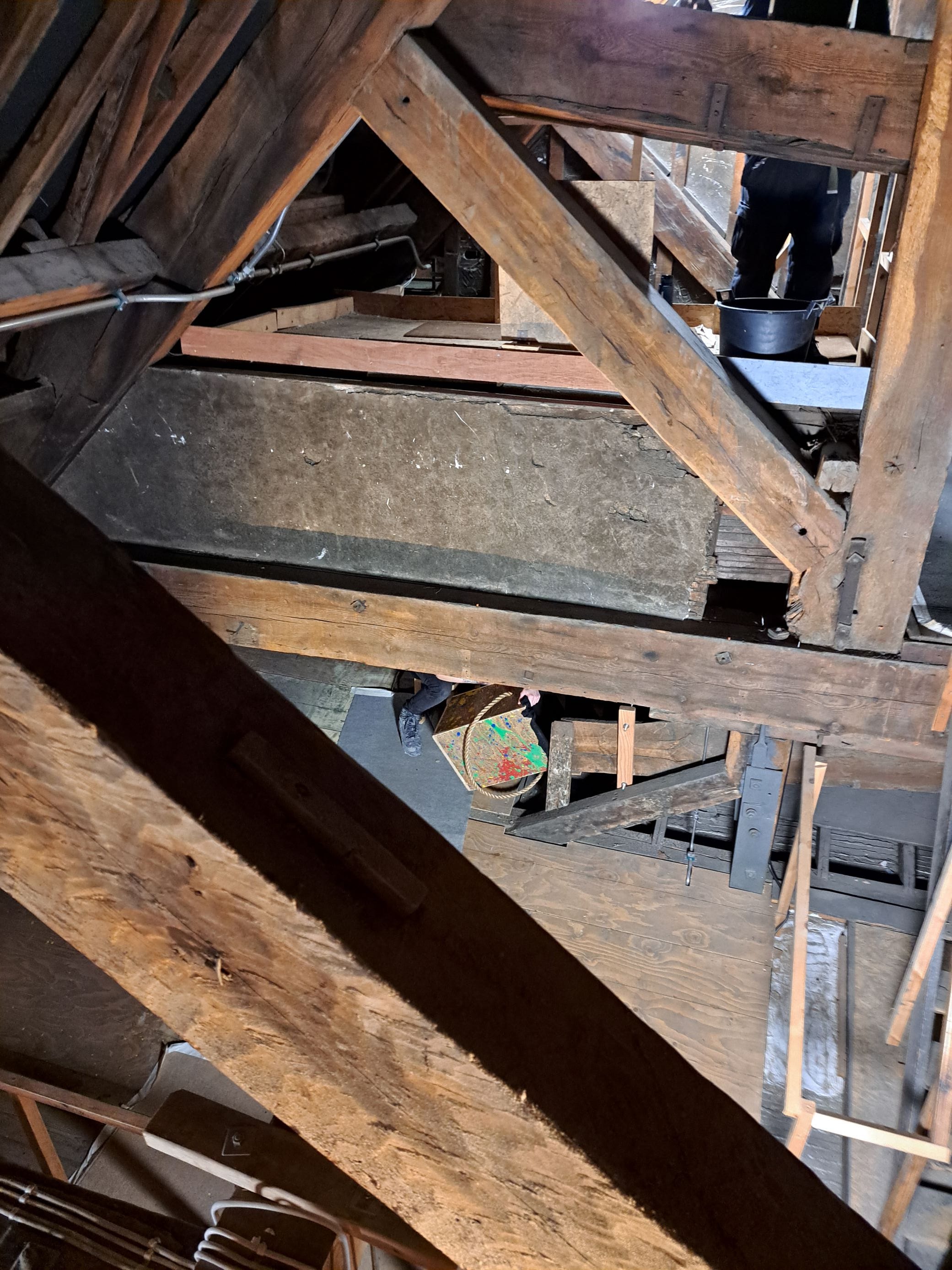
In the Bristol Old Vic roof, looking down at the thunder run - wooden balls sent through a wooden trough above the stage which gives a tremendous sound effect of thunder! (If you look closely you can see the operators hidden among the beams.)
But the tour was brilliant, the thunder impressive, and it was fun to be in the roof space to watch the two people operating it. Afterwards we went for coffee and cake in the Cathedral café, and then came home.
I spent the afternoon sorting out blogs for the Women’s History Network blog. We watched Dalgliesh in the evening, Bertie Carvel so stylish you don’t mind the daft story.
Sunday 22 December
I’ve been trying again to read H G Wells’s Mr Britling Sees it Through (1916), having given up on it a few weeks ago. It’s grown on me somewhat, though often over-written and Wells feels over-confident of his opinions and political analysis and generalisations about the “British”, who are all apparently represented by Mr Britling – yet it is interesting.
I worked on the novel, then emailed round some ideas for topics for the next West of England and South Wales’s Women’s History Network conference, and got positive responses from the committee members, which was nice.
Tuesday 24 December
I worked on the novel and Biography edits, and managed to finish a chapter of each.
Then I got out the Christmas doodads for the table – festive place mats, runner, napkins etc. Lots of candles. I felt inundated by Substack posts announcing that they weren’t going to do posts because it’s Christmas.
Wednesday 25 December
An uncanny silence hangs around the area. This afternoon we watched Anything Goes, recorded at the Barbican in 2021, which is now my Christmas go-to film. Lovely! I wondered when I could get back to my desk.
Thursday 26 December
Got back to my desk.
Friday 27 December
I worked on the novel.
I finished Mr Britling Sees It Through. It turned out to be fascinating, so many complicated and nuanced ideas about the war and the idea of people (especially Mr Britling) trying to make sense of it – of suffering. The pro-war view is more complex than just “pro” and “anti” I think. Wells is scathing about politicians’ stupidity and the self-interest of the ruling classes. But there’s a lot I don’t like – it often feels pompous, and wallows in atrocities – though I suppose if you are going to write about atrocities at all it looks like a wallow, dabbling your hands in the blood, enjoying the shock and horror, which isn’t really what the author’s doing at all…but it’s a very interesting book in spite of being hard going at times.
I read the introduction – the usual blah about how wonderful and important Wells is. Christopher Priest criticises reading autobiography into writers’ works and then does just that. Not only that, he implies Wells was not entirely honest about the autobiography he did admit to – when he said a character was based on a certain real person, Priest casts doubt on the statement and insists it’s actually based on someone else. After all a critic must know better than a writer what was in that writer’s mind.
I found an interesting article about the book in the Guardian, by Adam Roberts who’s written a biography of Wells.
Friday 3 January
I finished another read-through of the novel and felt discouraged when I realised one of the chapters really doesn’t work. I thought of a few ways of improving it, then decided the best thing was to delete it. It was.
Saturday 4 January 2025
I worked on the novel this morning, then in the afternoon we went to see a pantomime at the Redgrave Theatre – Jack and the Beanstalk – which was a lot of fun. The dame was brilliant and the scene with the ghost when we all had to shout “behind you” was hilarious.
I’ve been reading a collection of essays – Protest and Survival: The Historical Experience – Essays for E P Thompson. Some of them are very interesting – there’s one on Sylvia Pankhurst’s anti-war campaigning, others on Lord George Gordon and the death penalty, William Blake, Edward Carpenter, and Robert Wedderburn and literacy.
I’ve also been reading Ray Strachey’s biography of Millicent Garret Fawcett, which in spite of its sometimes gushing praise for its subject, ought to be as well known as Sylvia Pankhurst’s The Suffragette Movement, which has dominated suffrage history for so long. Of course, neither account is objective (what is?) but the non-militants were much more effective and radical than they’re given credit for.
Wednesday 8 January
We went to see The Lion King. It was bitterly cold in London.
The Lion King was fabulous, the choreography, the African music, the puppets so well done. (I wrote about it in my last post ) but I got a bit fed up with some people in the audience, the ones who don’t understand the meaning of “no phones”. I could put up with the crunching of buckets of pop corn and even some of the talking: you must expect these things in an audience full of children. What was truly distracting was the frequency with which the rectangular glare of someone’s phone burst out in the darkness, now to the right, now the left, now in the row in front of you. Perhaps these grown-ups weren’t enjoying the show, or perhaps they were enjoying it so much they had to announce the fact on social media, since waiting wasn’t an option. Eventually Gerard leaned forward and asked the woman in front of us to turn off her phone. She was startled and apologetic, so perhaps it really was that she didn’t realise, in spite of the reminder at the start of the show. But hers was only one in a sea of phones flashing.
Thursday 9 January
We came back from London. The journey was alright, we listened to Anthony Horowitz’s The House of Silk on the way, very enjoyable. The house was horribly cold though I’d left the heating to come on a couple of hours a day while we were away. It wasn’t enough.
I started rereading my favourite novel, Jane Eyre. It draws me in as much as it ever did, the intensity of it, the power of it, the voice, the sense of an independent – truly independent and not merely and shallowly ‘feisty’ – mind so strong.
Wednesday 15 January
A decent day, I worked on the novel and the Biography.
In the afternoon I went to a Friends of the Women’s Library meeting on Zoom, which consisted of suffrage play readings. They were a modern one read by the author, Sanda Anlin (she didn’t give her full name but I tracked it down on line) – the play was called Women Usurp! ‘Women usurp’ (to me anyway) echoes 1 Timothy 2:12: “But I suffer not a woman to teach, nor to usurp authority over the man, but to be in silence”, but I didn’t see a connection in the reading, so perhaps that’s not deliberate.
Then a contemporary play by Inglis Allen, The Suffragette’s Redemption, 1913 – a wife berates her husband for paying her prison fine, and they have an amusing and, on her side, illogical, argument – so its sympathies are not entirely positive. I can’t say I thought much of the script, the dialogue was repetitive and it went on a little too long, but I could see it could be quite funny to perform. Apparently a copy of the play has recently been purchased by the Women’s Library.
Then came an abbreviated version of Cicely Hamilton and Christopher St John’s lovely 1908 play, How the Vote Was Won. This was head and shoulders above the rest I thought, I like Hamilton’s work very much.
The readings were all very enthusiastically rendered and I thought it very brave of everyone to have a go.